


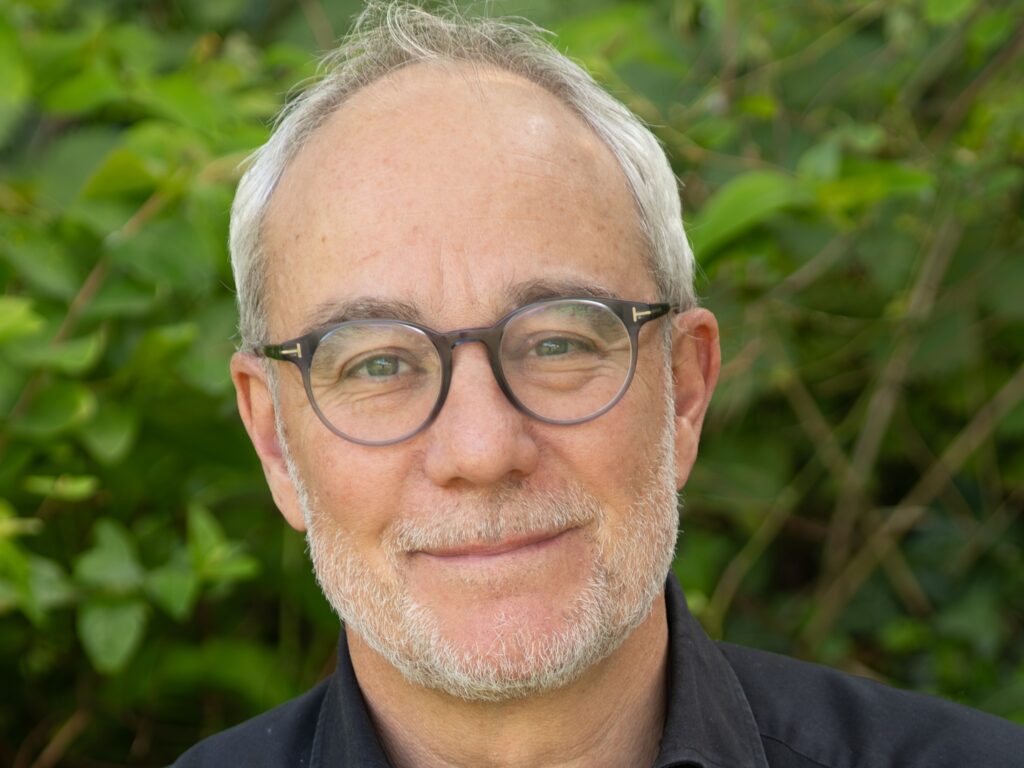
Robert Lobatto gives inaugural Sir Ken Robinson Lecture on his legacy and the future of education
15th June 26
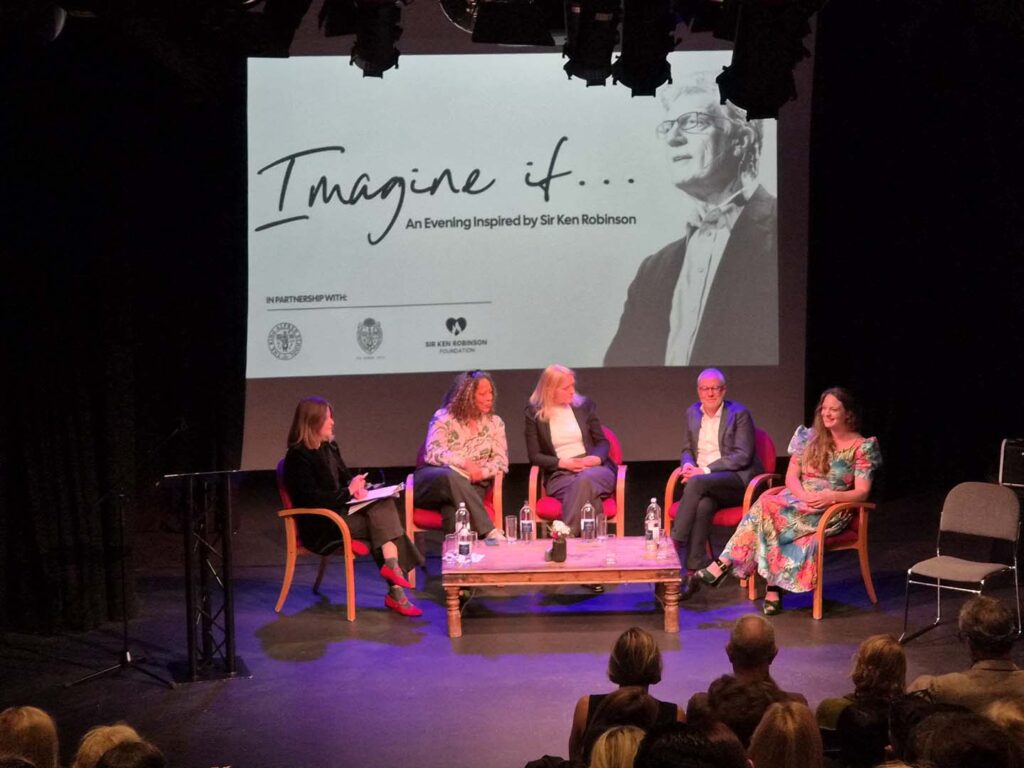
The inaugural ‘Imagine if…’ Sir Ken Robinson Lecture proved to be an inspiring evening celebrating creativity, learning and education.
The event began with an introduction from legendary educationalist Sir Ken Robinson’s daughter, Kate Robinson. This was followed with a talk by KAS’s outgoing Head, Robert Lobatto (who retired in the summer of 2026). The event concluded with a panel discussion featuring Kate and Robert alongside Evelyn Forde (leadership expert and former Headteacher), and Anne Marie Duff (actor, campaigner and parent).
This was the first in what is hoped will be a long-running series, continuing Sir Ken’s legacy of reimagining education and championing the power of creativity.
This is the speech given by Robert Lobatto in his last term as Head.
Full text of the inaugural Sir Ken Robinson Lecture
I want to take you back to the year 1991. John Major had recently become Prime Minister, the first Gulf War erupted and the Soviet Union collapsed. Arsenal won the last ever First Division title before the advent of the Premier League, Nirvana-inspired grunge hit the High Street, and we all got our first e-mail addresses on the new World Wide Web. Douglas Copeland coined the phrase ‘Generation X’, Anthony Hopkins unsettled us in ‘Silence of the Lambs’, and ‘Everything I Do, I Do For You’ by Bryan Adams spent an unfathomable 16 weeks as number one in the charts. It was also the year that a young Oxford graduate began his teaching career.
Picture a suburban school at the end of one of the tube lines in north London. There are semi-detached houses with cars on the driveways, a little park and a parade of shops with an old-fashioned butcher and baker. The school is in a dated 1930s building, with long corridors leading to classrooms on either side. There are wooden floors and dusty
blackboards, solid tables with mismatching chairs. One of these rooms is H2, History 2, and there standing at the door is a new history teacher. A checked jacket with obligatory elbow patches and slightly too big on the shoulders, light blue polyester shirt, khaki chinos and black lace-up shoes, this young man is standing by the door surveying his first ever class as they file into the room. ‘Welcome to Tudor England’ he says, and his teaching career begins.
It’s an up and down experience in those early days. Each evening driving home in his cherished 1980s Renault 5, he scores each lesson in his head out of five. Well, we started with a four, then a three, oh dear, Year 8 have yet to register above zero. Over time, things ease, routines emerge and he takes a quiet satisfaction in noting that his average score are on the rise. The marking becomes more manageable, relationships are built, the holidays roll around. He is meeting the expectations of the classroom, of the school, of the system. But there is something niggling away – is this it? And then one day there is a stac meeting. Generally not a highlight of the week, the young man trudges along with a cup of tea in hand, and as it is 2001, with a lined notebook and fountain pen. The kindly deputy head says we have a DVD to watch; presses play on the laptop/ projector combination and turns down the lights.
Like Princess Leia’s hologram projecting from R2D2, flickering onto the screen he sees a clip that awakes his curiosity. There is the face of Ken Robinson, talking about his 1999 report ‘All our futures: Creativity, Culture and Education’. It’s the early years of the New Labour government, and he has been commissioned to chair a panel setting out the future direction for UK schools. An academic at Warwick University, this is someone unknown, but the young History teacher finds himself leaning forward. For the first time since he took the step into the classroom, he hears things which in his bones he knows to be true.
Schools, Ken says, are not working well enough. They work for a particular group – those who are academic in a traditional sense and who aim for a traditional kind of university pathway. But he asks, how well do they really work for this group? And, then he raises the question – do they work at all for those with dicerent talents, temperaments and aspirations? Schools he says, are too much like factories from the industrial revolution, with their bells and time periods, their batching of pupils by age and standardised testing. They feel like conveyor belts, processing young people through a uniform system. What we need is something different. Think instead of a garden, where each pupil is like a seed not a product. Each has its own individuality, and the school’s job is to tend the soil, nurture the environment, and guide so the seed thrives and grows into its own unique self.
The young teacher thinks back to his lessons that day, the kids who were engaged and the ones that weren’t, the quality of work from some and the pained writing of others. However hard he tries, he knows that there are many for whom his lessons a chore to endure. The next day, a group sit around in the staff room. What did you think of the video yesterday, someone asks? I liked it, the young man says. Going to join the working party then? Nah, he says too much to do, and how could we do all that stuff anyway? Got to run, got to teach a revision session on the economic history of 1720s Lincolnshire, and of he trots.
Yet, a seed has been planted. The young man cannot get the DVD out of his head. And so, in what were the early days of the internet he visits the DFEE website via his dial-up telephone modem and downloads the PDF of the report. It takes a mere 45 minutes to come through. And as he reads it, it opens his eyes. Education it explains, has to address an individual’s relationship to the wider world. It should assist young people to become economically responsible and independent – a necessary requirement for a strong national economy. It should assist them to become empowered citizens who understand their rights and responsibilities – a necessary requirement for a strong democracy. It should assist them to have a strong understanding of their own culture and the culture of others with different family histories – a necessary requirement for social cohesion and harmony.
Education has to do more – it also has to attend to the interior world within.
And, education also has to do more – it also has to attend to the interior world within. It should nurture intellect – curiosity and creativity, the ability to analyse and evaluate. It should nurture physical health and mental well-being, and the capacity to make meaningful social connection. And it should nurture inner character and mindset, so that young people go into the world confident, purposeful and motivated.
The young teacher does not know Ken Robinson, and senses that he would feel somewhat intimidated if he met him. But he realises he now has a mentor by his side to help him on his journey. His pathway has become clear. Like Obi Wan Kenobi with Luke, he now has someone by his side to guide the way. And so, the young teacher surveys the scene around him – the environment that has become comfortable, the people he calls his friends. He packs his bags and waves goodbye. His Rubicon has been crossed.
Plaistow, East London, in the early 2000s is a very different kind of place. Urban to an extreme, a tree is a rare sight. The population is deprived and under-served, with one of the highest free school meals rates in the country. It is highly ethnically and culturally diverse, with many children born to first-generation immigrants. His new school has an energy and intensity which is not always channelled into productive learning. There can be a lack of respect which transforms into rudeness, and unruly behaviour which can become aggressive. This is a different world to get to know. What there is though, is a visionary headteacher imbued with Ken’s (soon to be Sir Ken’s) principles, and determined to put them into practise. And alongside him, is our still fairly youngish teacher – now the Deputy Head.
There are many chapters to be written about this time, but for this evening, two to mention. We start with Dance. Sir Ken was known for telling the story of Gillian Lynn, legendary dancer and director. Renowned soloist at Sadlers Wells, amongst many things she choreographed Cats and Phantom of the Opera. The first West End theatre named after a non-royal woman, is named after her. As a child however, Gillian was deemed disruptive. Whilst at her initial consultation for ADHD, the Doctor observed her dancing to the radio and famously advised her mother to enrol her not in a medical clinic but in a dance school. The rest, as they say, is history.
It’s a quintessential example of how the overriding instinct of the education system was to get her to conform to the predetermined way of doing things – even if it meant giving amphetamines to an 8-year-old child. In Ken’s words, the system was focussed almost entirely on ‘education from the neck up’. Gillian Lynn was an intelligent, creative, talented young girl – it was not she who was the problem, but the system in which she operated.
So, inspired, there in Plaistow the school championed dance. Rather than new classrooms, the building money went to a dance studio, the staffing money to a dance teacher. With rigorous practise, study, and student agency, dance performances became a highlight. One particular 14-year-old girl stood out. Dripping with attitude to
cover her insecurities, she had been a terrible student, always in trouble, never doing her work. She was however a great dancer. The confidence and skills she gained transferred into these areas previously untouched – developing academic focus and motivating her to get the results she required for her new course when leaving school.
Her story was one of many.
The second illuminating example from the time in Plaistow was the ‘Light project’. While Sir Ken carried some frustration that the ideas from the 1999 report were not adopted wholescale, they did have an important influence, as seen in the Creative Partnerships programme. His intellectual heft together with the political momentum he created, lead the government to commit serious funding to bring creatives to work alongside teachers and students in underserved areas. In Plaistow, this took the form of the Light Project, which brought together several of the ideas Sir Ken articulated – subject disciplines were connected, the learning space designed dicerently, students took charge of their own learning.
Professionals from the Arts worked alongside the pupils to produce remarkable films on the scientific, artistic and poetic qualities of light. Evaluated by academics from South Bank university, the project showed the wider impact of improved attendance, better attitudes to learning, higher test scores.But just as these initiatives were highlighting the way to a better future, storm clouds were gathering. The opposition was marshalling and assembling. Unsurprisingly, Ofsted struggled to see how these things could fit into their bureaucratic framework. Much more problematic however was the rise of the so-called ‘neotraditionalists’. Spearheaded by Michael Gove, they surveyed the system; their conclusion – that it was not yet rigid enough.
It wasn’t the case that there was insufficient student agency– there was in fact too much. It wasn’t the case that there was too much testing – there was in fact not enough.
It wasn’t the case that students were not having enough Art, Drama and Dance – they were in fact overindulging. Gove and co. took the ideas of the American academic ED Hirsch on the importance of the ‘Knowledge rich curriculum’ for young children in the early years, and distorted them into a fierce uncompromising ideological position on all learning until the age of 16.

Robert gave his speech to a packed audience of educationalists, parents and staff in The King Alfred Phoenix Theatre
They were undoubtably effective in changing the narrative. Drawing on the financial crisis of 2008, they painted a picture of a world where the only choice was for England to compete with the economies of the Far East, and the way to do this was by doubling down on their notion of a 1950s grammar school style approach for all. They made it up as they went along, notoriously devising the EBacc over a weekend because they had to come up with a policy announcement by the Monday. With a deep anti-intellectualism that revealed their brittle confidence, they mocked any challenge by characterising those who took a different view as ‘The Blob’.
From 2010, these forces had the upper hand. Narrow accountability measures became the be-all and end-all. Ofsted judged schools pretty much on this alone, and if they found yours to be ‘inadequate’, then it disappeared off the face of the map to become a new Academy. When in the fullness of time the Deputy Head left Plaistow for his next role, the Light project was cancelled, and the dance studio turned into a room for internal exclusions. It would be fair to say that during these dark unyielding times, the ideas of Sir Ken were not front and centre. The focus was on surviving the system. Achieving the accountability metrics became the aim, and if the children learned something along the way – well, that was a useful bonus.
But whilst the ideas may have faded, they continued to stay alive. The flame continued to flicker. And that is what finally brought our protagonist to King Alfred.
Here, there was the opportunity to do things differently. This was a school that had been set up 120 years before to fulfil so much of what Sir Ken now articulated. It was a school which was Independent – outside the constraints of the state system and freer to express its own philosophy. It was a school which already had in place many of the things that Sir Ken championed – a broad definition of success, an approach that started with the child, a culture that valued the voice of the people for whom the education was actually for – the students.
- The challenge he faced was to take this history, this independence, these rich ingredients, and blend them into 21st Century proof of concept. In short, to prove that their system was narrow, limited and misguided.
to demonstrate that you can have a school which is non-competitive, yet the exam results are excellent, and indeed superior to those who take the traditional conventional approach. - You can have a school where there are few rules, yet children learn how to effectively manage their relationships
- You can have a school which nurtures curiosity and creativity, and at the same
time provide rigorous, disciplined academic learning.
Mr Gove gave way to Plato and Aristotle, to Rousseau and Pestalozzi, to Montessori and Dewey – deeper thinkers who embraced the and not the or. A true education has always paid attention to the Head, and the Hand and the Heart – it is an aberration to say that we have to laud one aspect over the other, when the true work is to cultivate a
rich and measured balance.
It is probably not going to be a great reveal when I share that the protagonist of this story is indeed me. It has been a powerful journey and the guide who has been there by my side throughout has been Sir Ken. When pulled by the gravitational forces of the system to the darker regions of the universe, it is his voice that helped me stay true to my own values and beliefs. Not surrendering to the system is undeniably harder work than surrendering it to it. I have learned three important lessons along the way.
The first is that innovation makes you vulnerable. Doing new or different things, whether in Curriculum, Pedagogy or Assessment, all take huge effort to get right and time to refine. Not everything goes smoothly and critics can jump on bumps in the road as evidence that the whole concept is flawed. External systems including inspections,
admission policies, league tables, struggle to cope with ways of doing things that are outside of the norm. You have to strap yourself in for the ride.
The second is that implementing Sir Ken’s ideas require a different way of thinking about leadership. School leaders need to create environments which develop, support and ultimately trust their teachers to do what they do best – bring their passion for teaching to life. In parallel, teachers need to create an environment which develop, support and ultimately trusts their pupils to do what they do best – bring their passion for learning to life.
And my third lesson is that it works. This is true at KAS, and I also found it to be true in Plaistow, and indeed in Hillington near Heathrow airport where I was also a Head. I have seen it countless times in dozens of different schools across the country.
We need young people to grow up with the ability to analyse and evaluate, think for themselves and be creative, and relate well to other individuals and within teams.
This brings me to the last part of our story – what is the future? As I step away from schools after 35 years, 26 as a Head and Deputy Head, what do I see?
The central truth is that in 2026, Ken’s ideas remain relevant. In fact, not only do they remain relevant, but they are also more important now than ever. So why is this?
It is necessary for individuals to be economically independent both for themselves and the country. In order for this to happen in today’s world though, we need young people to grow up with the ability to analyse and evaluate, think for themselves and be creative, and relate well to other individuals and within teams. This has always been true but now with AI it is even more non-negotiable. In a world where the IMF says that 40% of global employment is exposed to AI, deeper human skills are absolutely crucial.
The second area is well-being. According to the Children’s Society, 15-year-olds in the UK have the lowest life satisfaction across 27 European nations and school experience undoubtedly plays a part – 42% of secondary students say academic performance is their number one daily worry. Rather than the bottleneck, high stakes, high pressure
GCSE system, which more than anything has been designed to hold schools to account, we need a system that recognises young people as human, which recognises what they have rather than what they do not have, and which creates the opportunity for them to flourish intellectually, emotionally and creatively.
Finally, we need our education system to change in order to support a more cohesive and compassionate society. We are living in an ever-more polarised society, and the answer has to start early in schools – it is when we see the human in each other that the walls of division come down.
So, how do we bring about the much-needed change? As Ken and Kate wrote in ‘Imagine If …’, Rock and Roll was not a government initiative. Movements of change are generated by people living everyday lives, and we can all play a part. Everyone in this room has some connection to Education – as a student or teacher, a parent or grandparent, uncle or aunt, friend or neighbour. The connection might be direct with a school, or via a business, community group or online. Depending on where you sit, you can make direct changes within the system, you can press for changes to the system, or you can take a stand from outside the system. And I invite you all tonight to consider what you can do to support the profound shift that is required. When I think about this last point I am reminded about the words of Hillel who was a great Jewish scholar and sage who lived around 2000 years ago. He has a three-part ‘mantra’:
If I’m not for myself, who will be for me?
It is always important to take responsibility for oneself and to look after one’s own welfare. No arguments there.
If I’m only for myself, what am I?
It is incumbent on all of us, including all of us tonight, to seek to bring about a positive change in the world and purposely and intentionally improve the lives of others – otherwise, why are we here?
And finally, if not now when?
Ss we come together this evening to recognise, celebrate and continue the work of the Sir Ken, we can see that the time for action is not at some far-off place in the future – the time for action is now.
 We’re delighted to be welcoming prospective families for visits this November.